

An AI-MI–supported study shows how to cut the cost of generating an image with a diffusion model by roughly ten times — not by changing the model, but by choosing better points along its sampling schedule.
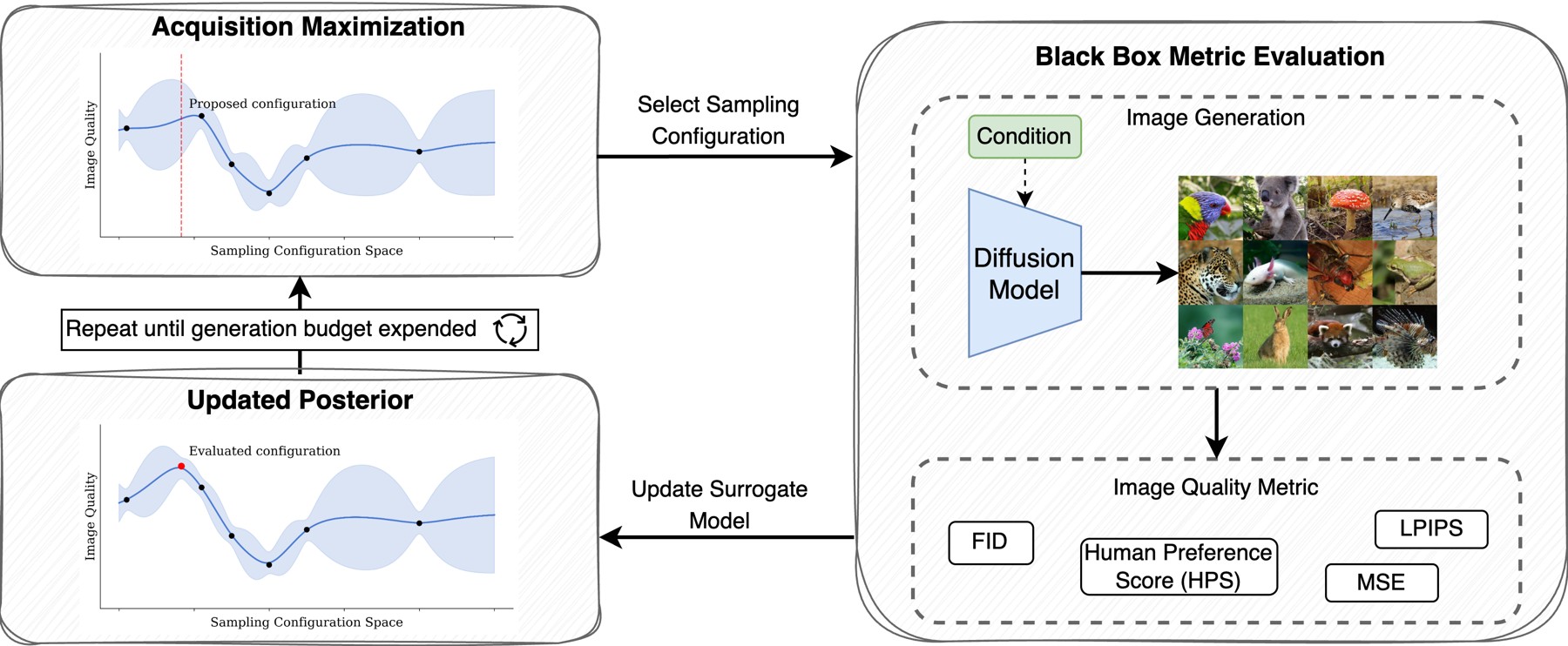
Sampling from a diffusion model means running a large neural network forward many times, which is where most of the compute goes. Considerable work has gone into faster solvers and samplers; far less into the question of which timesteps to solve at. A recent line of work optimizes a theoretically derived surrogate for sample quality. “Optimize Your Sampling: Tuned Diffusion Sampling with Bayesian Optimization” (OYS) drops the surrogate and treats timestep selection as a black-box optimization problem, tuning the target quality metric directly with Bayesian optimization.
A five-step OYS schedule retains 89–94% of the quality of a fifty-step schedule at one-tenth the inference cost. The method requires no additional training, applies even to distilled models, and improves both simple and sophisticated samplers such as Euler and DPM-Solver++. On text-to-image generation it outperforms both the default schedules and Align Your Steps, and it improves on the defaults for inpainting and other image tasks — in quantitative and human evaluation alike.
The paper is by co-first authors Travis Zhang and Christian Belardi (AI-MI junior investigator), with Justin Lovelace, Jin Peng Zhou, Saebyeol Shin, Carla P. Gomes and AI-MI associate director Kilian Q. Weinberger — all at Cornell University.
Source: arXiv:2608.18040