

- This event has passed.
AI-MI Seminar Series: Nima LeClerc (Diraq)
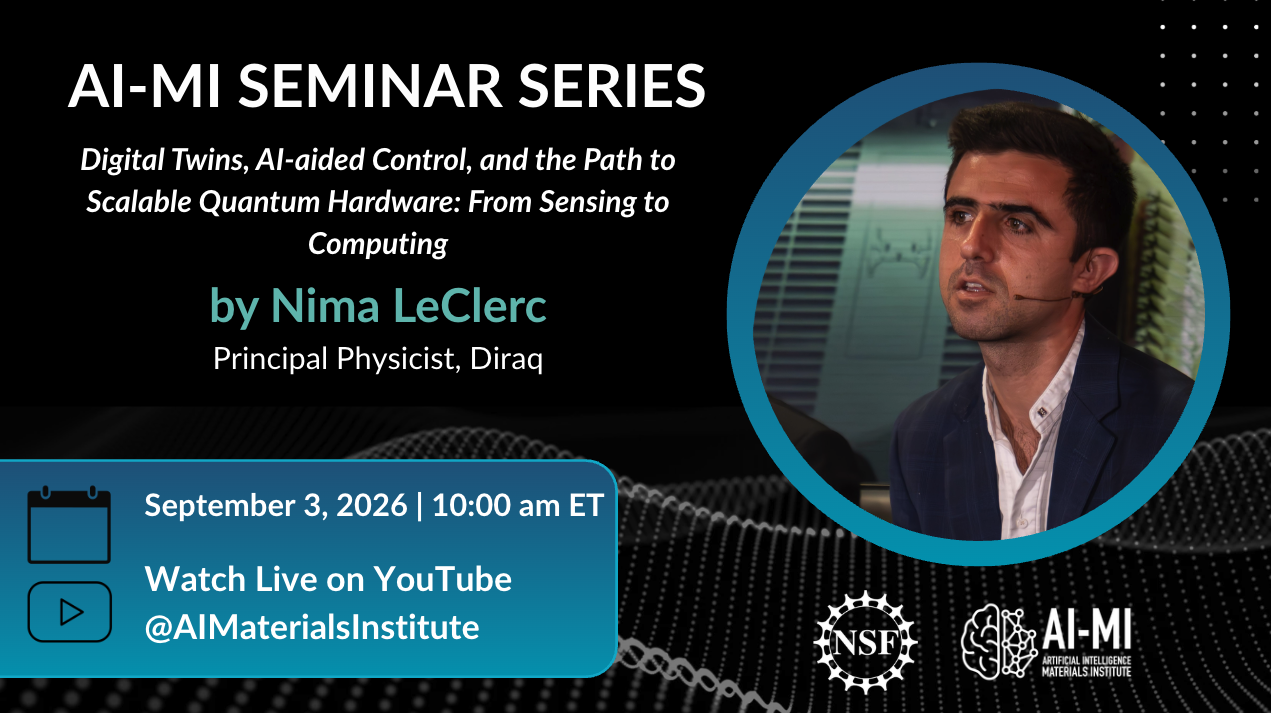
Watch the recording: youtube.com/watch?v=65Rq9gXMQ5c
Join us for the next AI-MI Seminar Series talk as we explore how digital twins and AI-aided control can make quantum hardware practical to build, calibrate and scale.
Every quantum device — sensor or computer — comes off the bench slightly different from the last one. Device heterogeneity, environmental drift, and manufacturing variability make calibration and control the real bottleneck to scale. This talk presents a unified digital twin framework that pairs GPU-accelerated simulation with meta-reinforcement learning and the scaling laws that say when adaptation is worth its cost.
Watch live at youtube.com/@AIMaterialsInstitute
Topic: Quantum devices, whether sensors or computers, suffer from intrinsic device heterogeneity, environmental drift, and manufacturing variability that make them difficult to calibrate and control at scale. In this talk, I’ll present a unified digital twin framework for designing and controlling quantum hardware, grounded in work I led at MITRE’s Adaptive Quantum Sensing Program and recent scaling law research. I’ll first introduce digital twins for quantum systems: high-fidelity GPU-accelerated simulation frameworks that enable rapid prototyping and adaptive controller design. Using defects in diamond-based magnetometry and multi-qubit gate calibration as concrete examples, I’ll show how digital twins dramatically reduce per-device calibration overhead by combining meta-reinforcement learning with adaptive control. This allows systems to learn generalizable control strategies across device populations and rapidly specialize to individual hardware instances. Next, I’ll present scaling laws that answer a fundamental question: when does adaptation actually pay for itself? Recent work shows that the fidelity gain from task-specific adaptation saturates exponentially with tuning effort and scales linearly with device variance, providing a quantitative criterion for optimal adaptation budgets. These laws hold across both quantum and classical control systems, suggesting they capture a deeper principle of adaptive optimization geometry. Finally, I’ll bridge from quantum sensing to quantum computing hardware design, outlining how digital twin methodology and meta-learning principles transfer to silicon spin qubits and broader quantum processor design. This perspective offers a path toward making quantum hardware more manufacturable, more efficient to calibrate, and ultimately more practical for real-world deployment.
Speaker: Nima LeClerc is a Principal Physicist at Diraq, where he leads digital twin development for the company’s spin-based quantum computers. He was previously Principal Investigator of the Adaptive Quantum Sensing Program at MITRE, developing quantum sensing technologies in partnership with NVIDIA. His research builds AI-driven frameworks that predict and optimize quantum computer and sensor performance — GPU-accelerated digital twins, Lindblad master equation simulation, and AI-aided adaptive control — spanning NV-center magnetometry, silicon spin qubits, and materials discovery, with work published at ICML, Physical Review, and IEEE. He did his undergraduate work in Materials Science at Cornell and his PhD in Electrical Engineering at the University of Pennsylvania, and has briefed Congressional committees on post-quantum cryptography standards.