

AI-MI Seminar Series: Adrian Del Maestro (University of Tennessee)
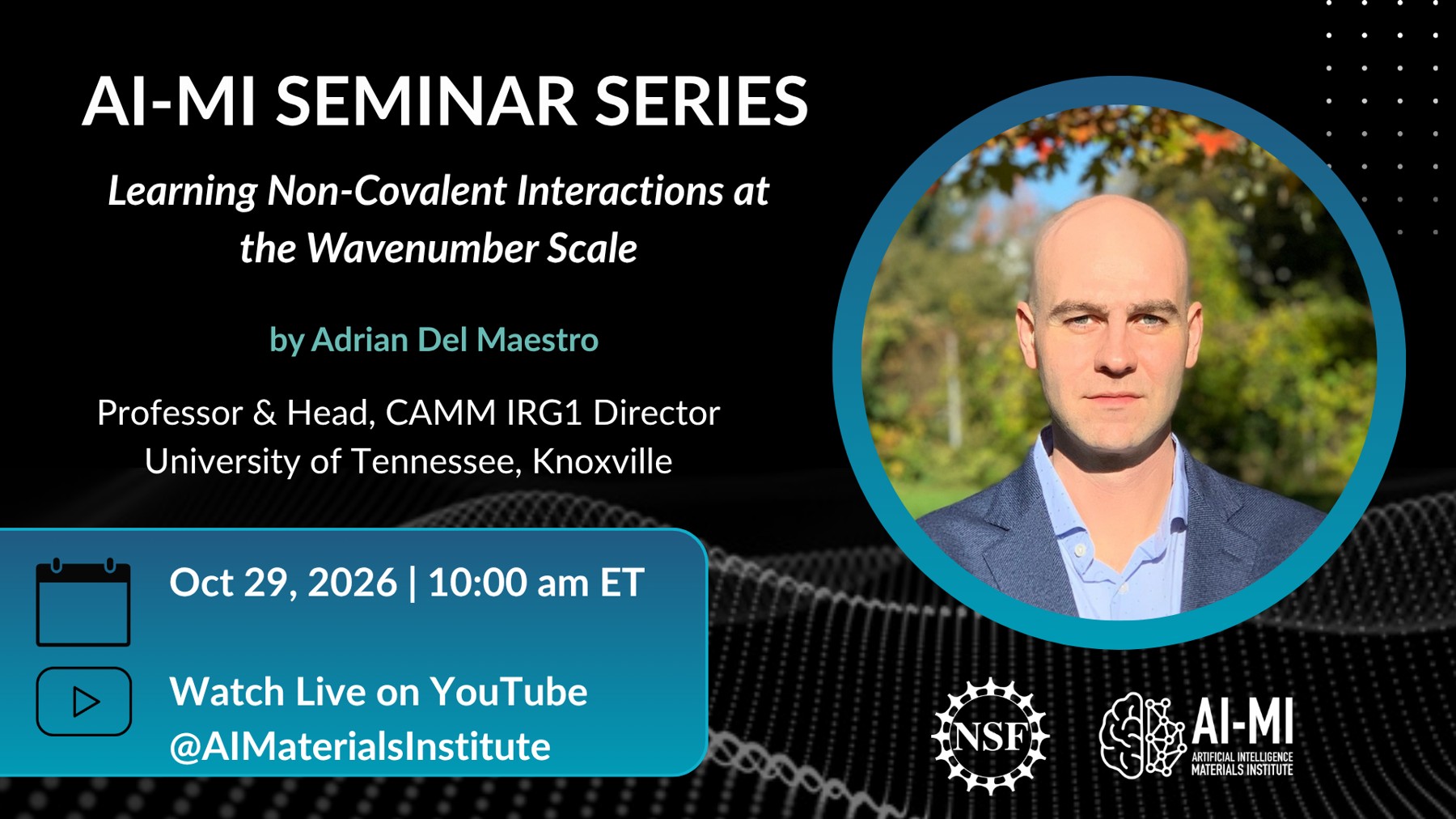
Join us for the next AI-MI Seminar Series talk as we explore how machine learning can push interaction potentials to the accuracy quantum many-body predictions actually require.
Helium adsorbed on atomically thin substrates hosts some of the most interesting quantum many-body physics available in the lab — but what you predict depends sensitively on the adsorption potential you start from. This talk combines actively selected coupled-cluster calculations, multi-fidelity Gaussian process regression and knowledge distillation from universal interatomic potentials to reach single-wavenumber accuracy, a level at which the physics itself changes.
Watch live at youtube.com/@AIMaterialsInstitute
Title: Learning Non-Covalent Interactions at the Wavenumber Scale
Topic: Helium on atomically thin substrates enables exotic quantum many-body physics, but predictions depend sensitively on the adsorption potential. For benzene and larger polycyclic aromatic hydrocarbons, we combine actively selected coupled-cluster calculations, multi-fidelity Gaussian process regression, and knowledge distillation from universal interatomic potentials to achieve single-wavenumber accuracy. Quantum Monte Carlo reveals qualitative changes in solvation relative to existing models.
Speaker: Adrian Del Maestro, Professor & Head, CAMM IRG1 Director, University of Tennessee, Knoxville
Adrian received his PhD in 2008 from the Department of Physics at Harvard University under the supervision of Subir Sachdev. Afterward, he performed postdoctoral research at the University of British Columbia and the Institute for Quantum Matter located at Johns Hopkins University.
From 2011 – 2020, he was an assistant, then associate professor in the Department of Physics at the University of Vermont. From 2018-2020 he served as the Director of the Vermont Advanced Computing Core.
He is currently a Professor in the Department of Physics & Astronomy and the Min H. Kao Department of Electrical Engineering and Computer Science at the University of Tennessee, Knoxville.