
seminar series
This bi-weekly series brings together leading researchers at the intersection of artificial intelligence, machine learning, and materials science. It highlights advances in AI-enabled discovery and data-driven materials research while fostering interdisciplinary collaboration and innovation.
Join us live or watch the recordings at youtube.com/@AIMaterialsInstitute
Upcoming Seminars
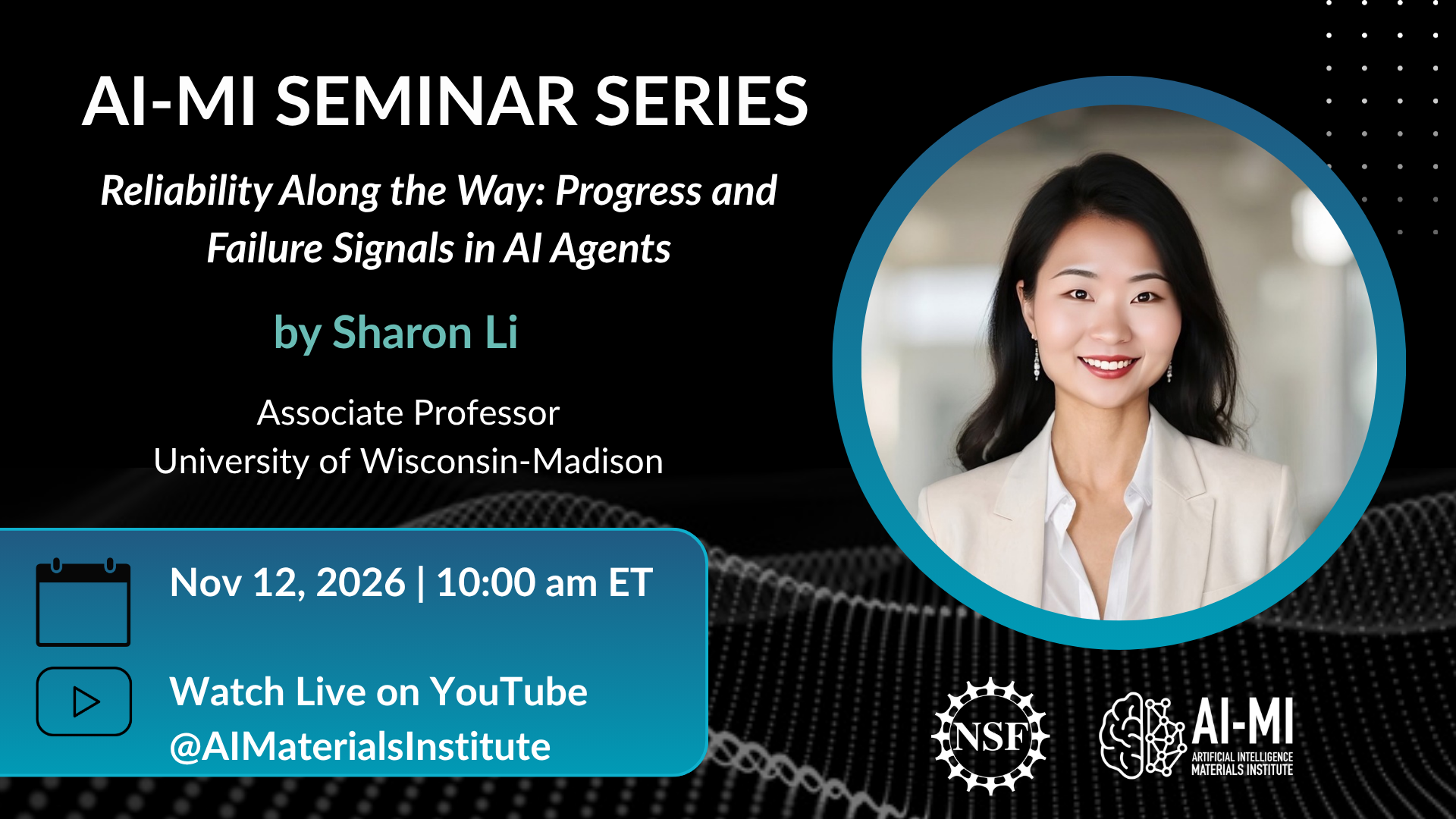
Thursday, November 12, 2026
10:00 – 11:00 am ET
Watch live on YouTube
@AIMaterialsInstitute
Sharon Li (University of Wisconsin-Madison)
Reliability Along the Way: Progress and Failure Signals in AI Agents
AI systems are rapidly evolving from models that generate responses to agents that execute long-horizon workflows, interact with tools and environments, and take increasingly consequential actions. This shift changes the nature of the reliability problem.
Thursday, December 10, 2026
10:00 – 11:00 am ET
Watch live on YouTube
@AIMaterialsInstitute
Ying Diao (University of Illinois at Urbana-Champaign)
Title TBA
Past Seminars
Adrian Del Maestro (University of Tennessee, Knoxville)
Learning Non-Covalent Interactions at the Wavenumber Scale
Streamed on Oct 29, 2026
Helium on atomically thin substrates enables exotic quantum many-body physics, but predictions depend sensitively on the adsorption potential. For benzene and larger polycyclic aromatic hydrocarbons, we combine actively selected coupled-cluster calculations, multi-fidelity Gaussian process regression, and knowledge distillation from universal interatomic potentials to achieve single-wavenumber…
Daniel Tabor (Texas A&M University)
Machine Learning Methods for Molecular Design and Reaction Discovery
Streamed on Oct 15, 2026
This talk will discuss strategies we have developed for efficiently navigating chemical space, and the physical insights we gained during their design and deployment. The first part will focus on our work in developing methods that accelerate the prediction of properties of molecules and materials at multiple length scales.
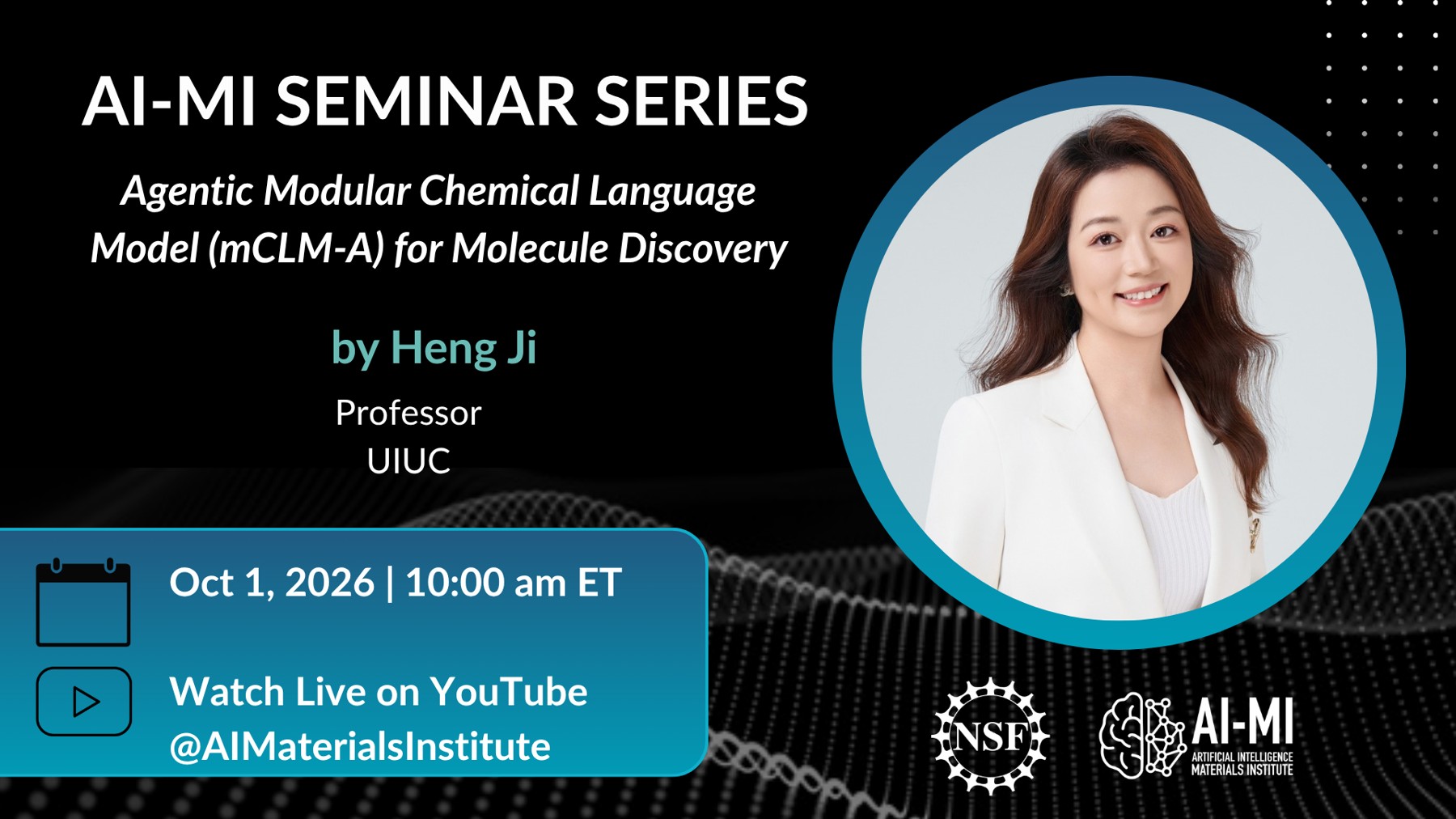
Heng Ji (UIUC)
Agentic Modular Chemical Language Model (mCLM-A) for Molecule Discovery
Streamed on Oct 1, 2026
Scientific discovery is one of humanity’s greatest engines of progress, yet the process itself remains painfully slow, expensive, and largely artisanal. Foundation models have transformed AI into a powerful engine for acquiring, organizing, and reasoning over human knowledge.
Tomás Arias (Cornell U)
Streamed on Sep 17, 2026
Machine learning is transforming materials discovery, but its greatest impact may come not from applying general-purpose AI to materials data, but from constructing learning methods that embody chemical and materials-physics knowledge. I will illustrate this through interpretable representations; differentiable design using Effective Atom Theory (EAT), differentiable Equiformer fast EAT (DEFEAT)…
Nima LeClerc (Diraq)
Digital Twins, AI-aided control and the Path to Scalable Quantum Hardware: From Sensing to Computing
Streamed on Sep 3, 2026
Quantum devices, whether sensors or computers, suffer from intrinsic device heterogeneity, environmental drift, and manufacturing variability that make them difficult to calibrate and control at scale. In this talk, I’ll present a unified digital twin framework for designing and controlling quantum hardware, grounded in work I led at MITRE’s Adaptive Quantum Sensing Program and recent scaling law…
Analyzing the Nonlocality of Sparse Autoencoder Features
Streamed on May 7, 2026
This talk examines how tools from machine learning and theoretical physics can be combined to better understand the internal representations of LLMs. Drawing inspiration from holographic duality, the speaker introduces a novel entropy-based measure to quantify how nonlocal learned features are in relation to input tokens—offering new insight into how information is structured and processed in these systems. Learn more.
Learning, Understanding, and Predicting Quantum Phases in Two-Dimensional Materials
Streamed live on Apr 23, 2026
The many-electron problem has resisted solution for decades — but neural networks are changing that. In this AI-MI Seminar, Flatiron Institute’s Shiwei Zhang presents a physics-inspired computational approach that has already surpassed state-of-the-art methods for two-dimensional electron systems, revealing exotic quantum phases and opening new frontiers in materials science. Learn more.
From Entropy to Epiplexity – Rethinking Information for Computationally Bounded Intelligence
Streamed live on Apr 9, 2026
This talk challenges foundational assumptions in information theory — asking whether computationally bounded observers can extract more from data than classical frameworks like Shannon entropy or Kolmogorov complexity suggest. The speaker introduces epiplexity, a new formalization of information that captures what real-world learners can actually use, with practical implications for how we select, generate, and transform data to build better AI systems. Learn more.
Literature-Informed Agents for Drug Discovery
Streamed live on Mar 26, 2026
Join us to explore how researchers are using AI to unlock chemical and biological knowledge hidden in scientific literature. The talk will highlight new approaches for automatically extracting data from papers and patents to build large-scale datasets that power molecule and protein design—advancing drug discovery, molecular property prediction, and AI-driven therapeutic development. Learn more.
Recovering Molecular Heterogeneity using Molecular Simulation, Electron Microscopy, and ML
Streamed live on Mar 12, 2026
Join us in exploring how researchers are combining molecular simulation, machine learning, and electron microscopy to better understand structural heterogeneity in complex chemical systems. This talk is presented by Erik Thiede, Assistant Professor of Chemistry at Cornell University. Learn more.
Polymer Biomaterials in a Self-Driving Lab
An Artificial Intelligence Era of Magnetism